
In short: 304 stainless contains roughly 18% chromium and 8% nickel, which is why it resists kitchen humidity, salt and cleaning chemicals for years. 201 replaces most of that nickel with manganese — it looks identical when new, costs meaningfully less, and corrodes noticeably faster in humid or coastal environments. 201 can be a rational choice for budget lines in dry climates; for the Middle East, Southeast Asia and any product that touches water daily, specify 304 and verify it.
The two most common quality complaints in this product category — rust spots at weld points and gray bloom on wire surfaces — both trace back to one purchasing decision: which stainless grade actually went into the order. Here is the difference in practical terms, without the metallurgy lecture.
The practical difference
| 304 (18/8) | 201 | |
|---|---|---|
| Composition | ~18% chromium, ~8% nickel | ~14–17% chromium, ~1% nickel, manganese substituted |
| Corrosion resistance | Handles daily moisture, salt air, cleaning agents | Adequate when dry; pitting and weld-point rust appear earlier in humid use |
| Appearance when new | Identical | Identical — this is exactly the problem |
| Relative wire cost | Baseline | Noticeably cheaper (nickel is the expensive ingredient) |
| Sensible use case | Dish racks, sink-adjacent baskets, coastal & tropical markets, premium lines | Dry-climate budget lines, decor-focused products with light water contact |
When 201 is a legitimate choice — and when it is not
We are a factory-direct supplier, not a purist: 201 exists because it serves a real price point, and for an inland, dry-climate market with a value-tier product line it can be a defensible specification. What is not defensible is paying for 304 and receiving 201 — or selling 201 into Jakarta, Manila, Dubai or coastal North America, where kitchen humidity and salt air will find every weld point within a year or two. If your market is the Middle East or Southeast Asia, treat 304 as the floor for anything that sees water: dish baskets, sink cabinets, drainage racks.
The third option nobody mentions: plated and coated carbon steel
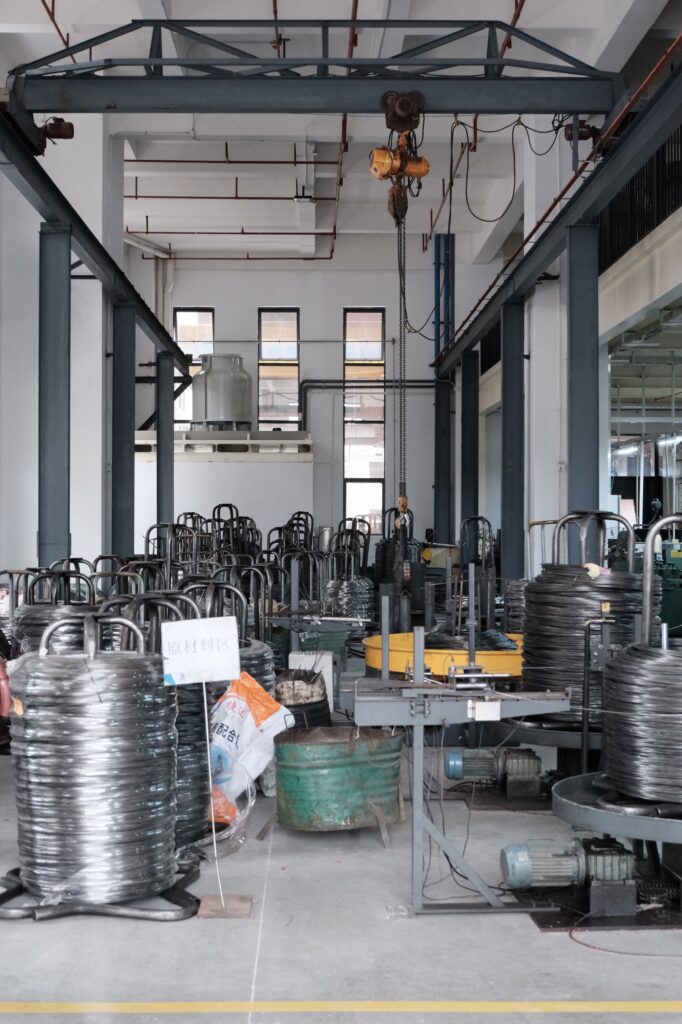
A large share of the world’s kitchen baskets — including much of our range — is not bare stainless at all, but iron/carbon-steel wire with an engineered surface: chrome plating, nano coating, or pickling passivation. Done properly, chrome-plated wire passes 48–96 hour salt spray testing and offers excellent value; the finish, not the base metal, does the protective work. The buying logic is different: for coated products you audit the surface treatment process and salt-spray reports rather than the steel grade. Ask where plating happens — suppliers whose production base plates in-house (as ours does) control that variable; those that outsource it cannot.
How to verify what you actually receive
1. Put the grade in writing. PO and spec sheet must name the grade (SUS304 / AISI 304) per component — basket wire, frame, runners — not just “stainless steel”.
2. Ask for mill certificates. A supplier buying genuine 304 wire has the mill test certificate. Reluctance to share it is information.
3. Spot-check with a spectrometer. Handheld XRF analysis is cheap through any third-party inspector (SGS, BV, TUV) and settles the question in seconds during pre-shipment inspection.
4. Do not rely on the magnet test. It is folklore: 201 and 304 are both austenitic and weakly magnetic after cold working. A magnet distinguishes neither reliably.
5. For coated products, ask for salt-spray hours. A written salt spray test duration (we test at 48–96 hours depending on finish) is a more meaningful quality signal than any grade claim.
FAQ
Is 201 stainless steel "bad"?
No — it is a lower-cost grade with a legitimate role in dry climates and value lines. The problem is undisclosed substitution, not the grade itself.
Will a magnet tell me if a basket is 304?
No. Both grades can show weak magnetism after forming and welding. Use XRF spectrometer testing during inspection instead.
Which grade should I specify for the Middle East or Southeast Asia?
304 for anything with daily water contact. Humidity and salt air accelerate corrosion on 201 dramatically in these regions.
Are chrome-plated baskets inferior to stainless?
Different, not inferior. Quality chrome plating over carbon steel passes 48–96 h salt spray and serves most kitchen applications well at a better price. Judge coated products by their surface-treatment reports.
Can you produce the same basket in both grades?
Yes — most SOWELLE wire products can be quoted in 304, in 201 on request, or chrome-plated iron, clearly labeled per option, so you can position different price tiers honestly.
Related: our load capacity guide explains what basket weight ratings actually mean. Browse products: full catalog.
Questions about a spec sheet or a size mix for your market? Contact us — we reply within 24 hours.