
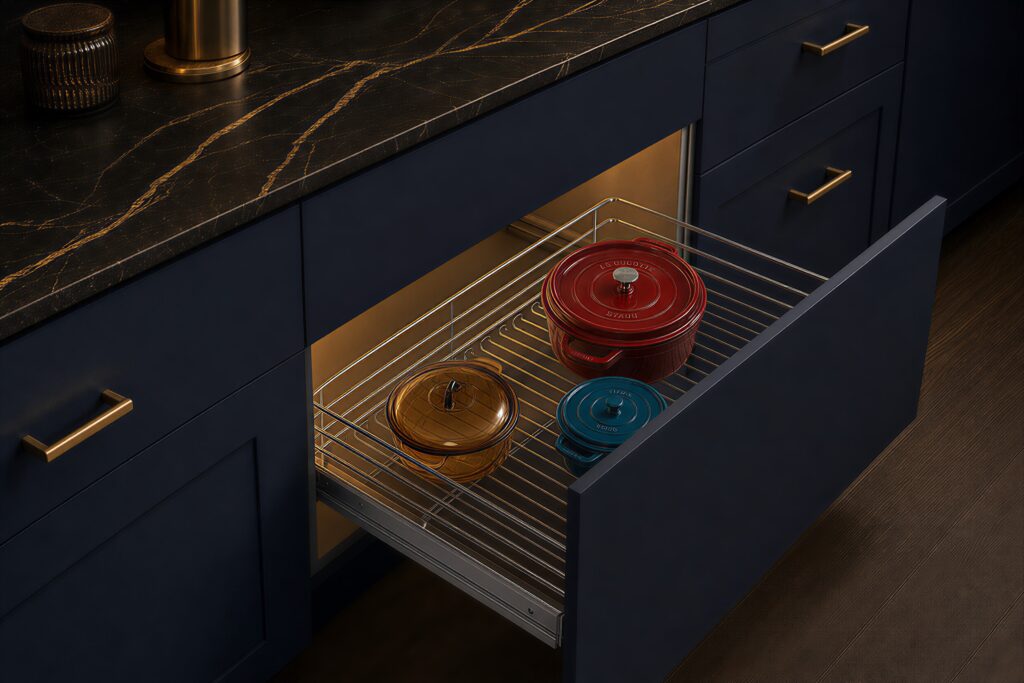
In short: “Load capacity” on a pull-out basket datasheet is the working load the runner pair can carry through normal use without measurable degradation. The number depends on the product type — a 300 mm spice pull-out is not rated the same as a 900 mm pantry pull-out. Realistic ranges: 15–20 kg for 300–400 mm baskets, 25–30 kg for the 500–600 mm sizes we ship most, and 30–40 kg for 800–900 mm baskets on under-mount runners. The most common mistake is treating the rated load as a hard ceiling — the runner is usually the load-limiting component, and overloading the front-most position concentrates more stress than a distributed load.
What “load capacity” actually means
A few terms get used loosely. Worth being clear about each:
- Dynamic load — the load the runner pair carries during normal open-close cycles. This is the spec that matters in daily use.
- Static load — what the runner pair can support when not moving. Higher than dynamic.
- Distributed load — load spread across the basket bed evenly. This is how datasheet ratings are tested.
- Point load — load concentrated in one place. A 20 kg pot at the front-most position imposes much more stress than the same 20 kg distributed.
Realistic load ratings by product type
| Product | Typical use | Rated working load |
|---|---|---|
| Pull-out basket 300–400 mm | Spice, condiments, light items | 15–20 kg |
| Pull-out basket 500–600 mm | Cookware, mixed contents | 25–30 kg |
| Pull-out basket 800–900 mm | Wide base storage | 30–40 kg |
| Tall pantry pull-out stack | Canned goods, dry stock | 30–45 kg total |
| Corner turntable shelf | Cookware on lazy susan | 8–15 kg per shelf |
| Magic-corner shelf | Swing-out kidney | 10–15 kg per shelf |
| Wall lift-up door | Cabinet door + insert | 3–12 kg door weight |
| Wire mesh drawer organizer | Utensils, light items | 5–10 kg |
Ratings assume under-mount runners or appropriate carrier mechanism, distributed loading, and full extension.
How to size load to your application
A simple working rule: choose a product rated at roughly 1.5× the expected loaded weight. A pantry projected to hold 25 kg of content should sit on hardware rated for 35–40 kg. The headroom absorbs distribution variance and the loaded weight of the basket itself.
What to avoid:
- Loading point weights at the front-most position — a heavy stand mixer on the basket front imposes more stress than the same mixer distributed in the middle.
- Stacking heavy items in a column — concentrates load on a small footprint, accelerates runner ball-cage wear.
- Treating the rated load as a hard limit you can dance around — runners that occasionally see 110% of rating wear out faster than runners loaded to 70%.
What we test on every batch
Every runner assembly we ship goes through a loaded cycle test before packing — not just sampled units. The test loads the basket and cycles it open-close enough times to surface early-life mechanical defects. Catch rate at this gate is around 0.5–1% on stable production runs and is the early indicator that something upstream needs attention.
FAQ
Q: My buyer’s spec says “tested to 100,000 cycles.” Is that better than 30,000?
A: It depends on the load. 100,000 cycles at light load is less demanding than 30,000 at full rated load. Always look at the cycle count and the load together.
Q: What load does a typical 600 mm under-mount runner actually handle?
A: Around 25–30 kg dynamic distributed load for the runner pairs we use on our standard programs. We choose the runner spec to match the basket; the runner is usually the load-limiting component.
Q: How does load capacity change as the runner wears?
A: Marginally. Ball-cage races wear and lubricant migrates over years of use, but the wear is usually slower than the cabinet lifetime. Field failures are almost always overloading, not the load capacity gradually dropping.
Q: Can I request a custom higher-load rating?
A: For tall pantry programs where the loaded weight runs higher, yes — there are runner specs designed for heavier loads. We will discuss what fits your program and what the cost trade-offs look like.
Q: What is “soft-close to 30 kg” specifying?
A: The soft-close damper is tuned to bring a 30 kg loaded basket to a controlled stop. Above this weight, the damper does not arrest cleanly and the basket lands harder. Match damper sizing to the maximum loaded weight you expect.