
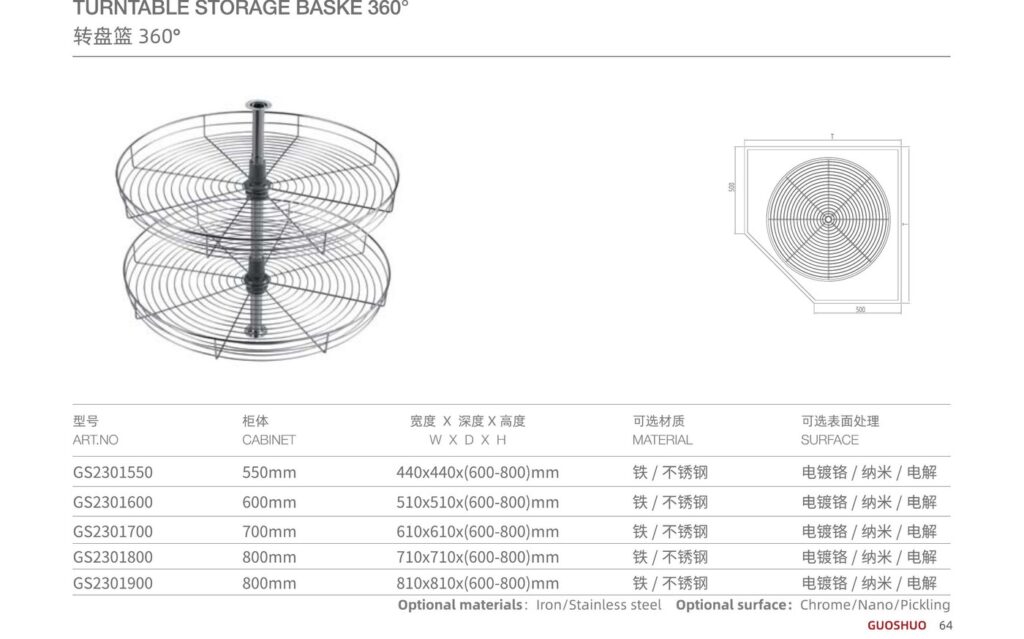
In short: A turntable basket system is a rotating shelf on a center post inside a corner cabinet. Three architectures cover most cases — 180° (half-rotation, used in single-door corners), 270° (three-quarter rotation, used in blind-corner cabinets), and 360° (full rotation, used in cabinets with two adjacent doors). Turntables recover roughly half the dead volume in a corner cabinet at a much lower cost than pivot-and-pull-out systems. For most residential L-shape kitchens, a turntable is the practical answer.
The three architectures, plainly explained
180° turntable
Two half-circle shelves on a center post. The shelves rotate 180° and stop against a notch — they cannot keep rotating without the user lifting and resetting. Used in corner cabinets where only one face is a door.
- Cabinet requirement: minimum 800 × 800 mm.
- Shelf load: 8–12 kg.
270° turntable
Three-quarter-circle shelves for blind-corner cabinets where one face is a fixed panel against a wall. The shelf shape clears the door opening, letting the user reach the rear corner.
- Cabinet requirement: minimum 800 × 900 mm with a clear single-door opening.
- Shelf load: 8–12 kg.
360° turntable
Two full-circle shelves rotating freely. Used in square-corner cabinets with doors on both adjacent walls — content can be accessed from either door.
- Cabinet requirement: minimum 900 × 900 mm.
- Shelf load: 10–15 kg.
How turntables compare to pivot-and-pull-out systems
| Variable | Turntable | Pivot-and-pull-out |
|---|---|---|
| Volume recovery | ~50–55% | ~65% |
| Cost | Low to mid | Higher |
| Installation | One person, around 25 min | Two people, around 45–60 min |
| Best fit | Residential, mid-tier programs | Upper-tier programs |
The center-post trade-off
Turntable shelves rotate around a vertical post that takes up some space at the cabinet center. That central column is volume the system cannot reach. Pivot-and-pull-out systems do not have this limitation, but cost more. For most residential L-shape programs, the turntable trade-off is reasonable — the lost center volume is offset by the lower hardware cost and simpler installation.
Specification checklist
- Cabinet face configuration — one door (180°), one door + blind face (270°), or two doors (360°).
- Cabinet inner width × inner depth at the floor.
- Shelf diameter chosen with clearance to the cabinet walls.
- Shelf material — chrome-plated wire for entry, 304 stainless or stainless rim with melamine deck for mid-tier.
- Bearing type — sealed bearings run quietly for years; bushing bearings are cheaper but get noisier over time.
- Height adjustability — most carriers allow shelf adjustment in 25 mm steps.
FAQ
Q: Are 360° turntables prone to spillage?
A: Only if content is loose and the user rotates fast. A 35–45 mm rim around the shelf contains most cookware; for bottles, divided inserts help.
Q: How loud is a turntable in use?
A: Sealed-bearing turntables operate quietly. Bushing-bearing versions get louder over time as bushings wear.
Q: Can I retrofit a turntable to an existing corner cabinet?
A: Yes — the carrier post screws to the cabinet floor and ceiling. The constraint is matching the post height to the cabinet inner height; most systems are telescopic across a usable range.
Q: What’s the best shelf material for coastal kitchens?
A: 304 stainless. Chrome-plated wire is fine in dry kitchens but not where chloride exposure is a regular factor.
Q: How do turntables compare in volume to drawer-based corner solutions?
A: A 360° turntable recovers about half the cabinet volume. Diagonal-drawer corners recover more but cost significantly more. For most residential cases, the turntable is the practical choice.