
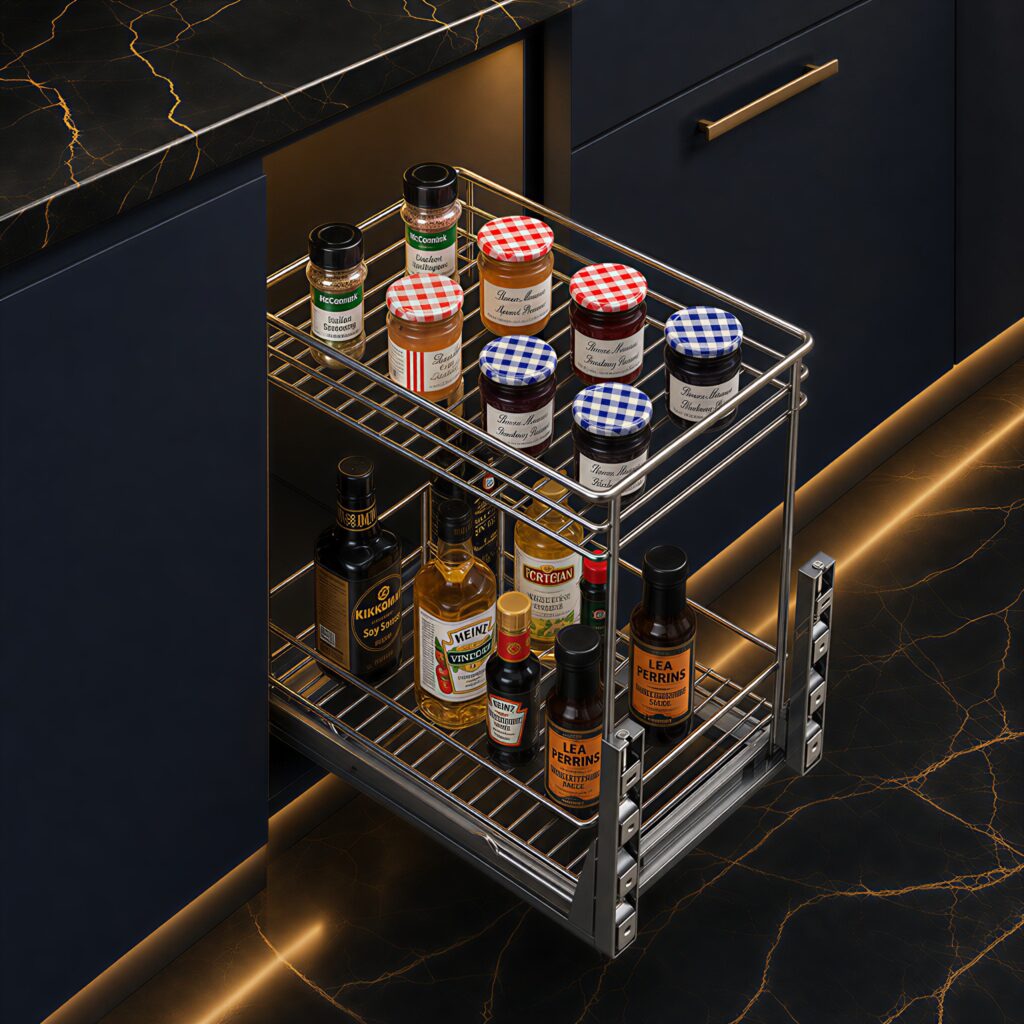
In short: Both 304 stainless steel and chrome-plated iron wire still earn their place in a 2026 kitchen hardware program. We use 304 stainless across our mid- and upper-tier baskets — the substrate is itself the corrosion barrier, so there is nothing to wear through. We use chrome-plated low-carbon steel wire on entry-tier baskets, where it is honestly competitive when the plating thickness and substrate quality are controlled. The right answer depends on the cabinet tier and the kitchen environment — not on which material sounds more premium.
The straightforward comparison
304 stainless steel and chrome-plated iron wire have different long-term behaviors, and pretending one is universally better than the other does the buyer no favors. Here is how we think about each.
304 stainless steel
The chromium content (around 18%) and nickel content (around 8%) build a passive oxide layer that protects the substrate without any added coating. There is no plating to wear off, no electroplated layer to pit, and welded joints — when TIG-welded properly and passivated — do not become the first failure point.
This makes 304 the more honest choice when:
- The kitchen is in a coastal or humid region.
- The cabinet tier sells with a long service-life expectation.
- The basket is visible — glass-fronted cabinets, open shelving — where finish degradation would be noticed.
Chrome-plated iron wire (low-carbon steel substrate)
Chrome over a nickel underlayer gives a hard, reflective finish on a low-cost substrate. When the plating is done well, the product is reliable for years in a typical dry kitchen. When the plating is done poorly, it fails inside the warranty.
The variables that decide whether a plated basket is honest or a corner-cut:
- Plating thickness — adequate nickel underlayer with proper bright chrome on top, controlled batch-to-batch.
- Weld quality at the joints — resistance spot welds are the first place plating can fail; clean welds with no flash are necessary before plating.
- Substrate cleanliness — a degreased and acid-pickled substrate accepts plating uniformly; a contaminated one pits within months.
Done right, chrome-plated iron wire is not a compromise — it is a different price point for a different program. We salt-spray test chrome-plated batches at 48–96 hours per ASTM B117 sampling.
How we decide which to recommend
| Buyer situation | Our recommendation |
|---|---|
| Entry-tier cabinet program, dry-climate market | Chrome-plated iron wire |
| Mid-tier cabinet program | 304 stainless steel |
| Coastal or humid-region program | 304 stainless steel |
| Visible interior, design-led program | 304 stainless steel |
| Mixed program for varied markets | Both tiers under one supplier — simpler logistics |
Realistic load ratings
For a standard 600 mm pull-out basket pair on an under-mount runner — what we ship most — the dynamic load is around 25–30 kg distributed. Side-mount versions are in the 20–25 kg range. These are honest working loads, not headline numbers we hope nobody tests. The basket itself rarely fails; the runner is the load-limiting component, and we choose runners matched to the basket rating.
FAQ
Q: Will chrome plating rust over time?
A: Well-plated chrome wire in a typical dry kitchen lasts comfortably through the cabinet’s expected lifetime. Where it fails is in chronic moisture exposure, especially at welded joints, and when the plating thickness was inadequate from the start.
Q: How can a buyer tell if a “stainless” basket is really 304?
A: Mill certificates with batch traceability, and — if needed — an XRF check showing the chromium and nickel content. We are happy to provide the mill cert on request.
Q: What is the price difference?
A: For a 600 mm pair, 304 stainless is roughly two to two-and-a-half times the chrome-plated equivalent at ex-works pricing. Worth it for mid-tier and above; overspec for entry-tier.
Q: Do you mark which baskets are stainless versus plated?
A: Yes — the material grade is part of the SKU code on every box. No mixing batches.
Q: What about aluminum-frame baskets?
A: They exist and have specific niches, but they are not our specialty. We make steel-substrate baskets — chrome-plated low-carbon and 304 stainless — and we make those well. Aluminum buyers are better served by factories that specialize in extrusion-frame work.