
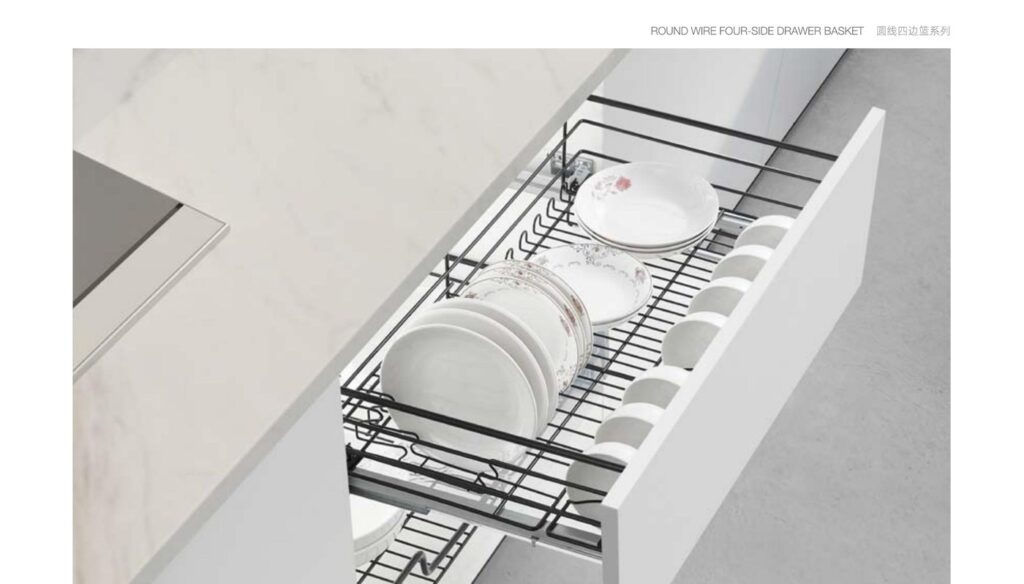
In short: Soft-close damping is a small hydraulic piston built into a cabinet runner or hinge that slows the closing motion over the last few centimeters of travel. The drawer or door reaches its closed position softly instead of slamming. The technology is mature, the price has come down, and it is now standard in mid-tier kitchens. The variables that still matter — and the ones we pay attention to when we assemble systems — are temperature stability, mass matching to the damper, and whether the damping mechanism is integrated into the runner or clipped on as an add-on.
What soft-close actually does
A drawer pushed shut at normal speed closes at roughly half-a-meter to a meter per second. Without damping, the closing impact wears the strike plate, generates noise, and over years adds up to visible mechanical wear. With damping, the last 30 to 50 mm of travel is slowed by a hydraulic piston moving through silicone oil. By the time the drawer seats, closing velocity is low enough that the impact is barely audible.
This is not new — the technology has been on premium European kitchens for fifteen years. What changed is that it is now affordable in the mid-tier, and buyers expect it as a default rather than an upsell.
Hydraulic vs gas-cylinder dampers
Two main damper types in the kitchen hardware market:
- Silicone-oil hydraulic dampers — a piston moves through a sealed cylinder of silicone oil. Resistance is velocity-dependent, so fast closing meets more resistance than slow closing. Temperature-stable across the normal kitchen range. This is what we specify in most of our systems.
- Gas-cylinder pneumatic dampers — a piston compresses air through a restrictor. Cheaper. Performance varies with temperature; a cold-room kitchen will feel different from a warm one. Reasonable for budget programs where temperature stability is not critical.
Integrated vs clip-on
| Type | What it is | Where it fits |
|---|---|---|
| Integrated runner | Damper built into the runner body | Mid and upper tier — cleanest install, fewest failure points |
| Clip-on damper | Universal damper that clips onto the runner side or front rail | Entry tier, retrofit jobs |
How we choose damping per product
Pairing a damper to a drawer or door means matching the damper’s mass window to the loaded weight. A damper sized for a 5 kg drawer will not arrest a 20 kg pantry pull-out cleanly — the drawer overshoots and seats hard. A damper sized for 20 kg will feel sluggish on a 5 kg drawer.
What we look at when we spec a system:
- Expected loaded weight of the drawer or door.
- Whether the cabinet runs in a stable temperature range or sees wide swings.
- Whether the damper is integrated or clipped on — integrated for premium programs, clip-on for entry.
FAQ
Q: How is soft-close different from a self-closing runner?
A: Self-closing uses a spring or magnet to draw the drawer the last few centimeters without damping. Soft-close adds the hydraulic restriction so that the spring-pulled closing is also velocity-controlled. Most modern integrated runners do both — self-close from the last 50 mm and damp the final 30 mm.
Q: Why does my soft-close feel slower in cold weather?
A: Silicone-oil viscosity rises as temperature drops. Below freezing, hydraulic dampers slow noticeably; in deep cold they may not retract fully before the next cycle. For unheated storage areas, a gas-cylinder damper is a better fit.
Q: How long do hydraulic dampers last?
A: For typical residential use, well past the expected lifetime of the cabinet. The most common cause of replacement is seal hardening over a long timeframe, not piston wear.
Q: Can I retrofit soft-close to existing cabinets?
A: Yes. Clip-on hinge dampers retrofit to most hinge brands; clip-on runner dampers fit standard side-mount runners. Match the damper’s mass window to the door or drawer weight.
Q: Is the soft-close adjustable?
A: Premium integrated runners have a tension cam that tunes engagement to door weight — typically a small screw on the runner body. Clip-on dampers are usually fixed.