
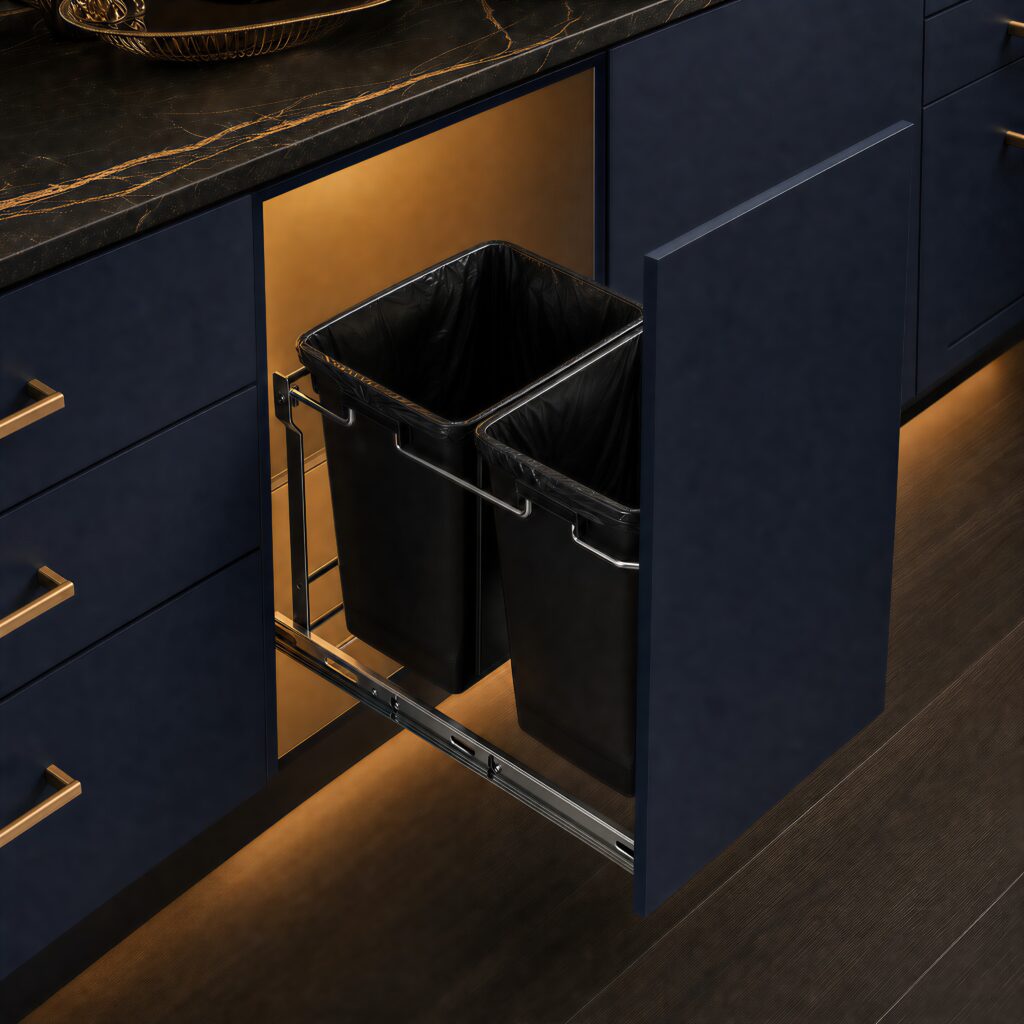
In short: a waste pull-out is specified by the cabinet it goes into, not by the litres it holds. As a rule, 300 mm cabinets take a single bin, 400 mm cabinets take a single large or a slim double, and 600 mm cabinets take a double or triple system. The number that actually decides the fit is the internal clear width after side panels and runners — usually 30–40 mm narrower than the nominal cabinet size.
Waste systems generate more sizing complaints than any other category we ship, and almost always for the same reason: someone ordered by bin capacity when the cabinet dictates the answer.
How waste pull-outs are actually sized
Three dimensions have to work at once:
- Nominal cabinet width — the module the kitchen was designed around (300, 400, 450, 600 mm).
- Internal clear width — nominal width minus two side panels (typically 16–18 mm each) minus runner clearance. A 400 mm cabinet usually leaves about 364 mm of carcass and less again once the runners are in.
- Internal depth and height — the bin has to clear the door hinge on the way out and the plinth underneath.
Get those three from the cabinet drawing before looking at any bin catalogue and the rest is straightforward.
Cabinet width to configuration
| Cabinet width | Typical configuration | Notes |
|---|---|---|
| 300 mm | Single bin | Common in apartments and utility runs; the narrowest practical waste pull-out |
| 400 mm | Single large bin, or slim double | The volume size in most modular kitchens |
| 450 mm | Double bin (waste + recycling) | Where most two-stream projects land |
| 600 mm | Double large, or triple for compost separation | Popular in North America and project work |
Litre capacity follows from the configuration rather than driving it. Two-stream systems in a 450 mm cabinet typically land somewhere near 2 × 15 L; a single bin in 400 mm is usually in the 25–35 L range. Exact volumes per model are listed on each product page.
The three clearances people forget
Door thickness and hinge intrusion. On a face-frame cabinet the frame lip eats into the opening. Measure the narrowest point of the opening, not the carcass.
Plinth height. Bottom-mounted systems need the plinth to clear; door-mounted systems ride with the door and care less.
Door-mounted vs base-mounted. Door-mounted pulls the bin out when the door opens — better user experience, tighter tolerance requirements. Base-mounted is more forgiving on cabinet variation and easier to retrofit.
What to send a supplier for an accurate quotation
Five lines are enough: cabinet widths and quantity per width; internal clear width if you know it; framed or frameless construction; door-mounted or base-mounted preference; destination market. With that, quoting takes minutes instead of a week of back-and-forth.
FAQ
Can I fit a double bin in a 400 mm cabinet?
Usually yes, with slim bins, but the usable volume per stream drops sharply. If two-stream separation matters to the end user, 450 mm is the more comfortable module.
Is bin capacity or cabinet width the right thing to order by?
Cabinet width. Capacity is a consequence of the width, the depth and the configuration. Ordering by litres alone is the most common cause of a system that will not fit.
What is the difference between door-mounted and base-mounted?
Door-mounted systems attach to the cabinet door and travel with it, which feels seamless but demands tighter cabinet tolerances. Base-mounted systems sit on the cabinet floor and are more tolerant of variation — often the safer choice for retrofits.
Do you supply bins, or only the frame and runners?
Both. Systems ship as a complete assembly with frame, runners and bins. If you have a preferred bin supplier we can quote the hardware alone for an OEM programme.
Working on a specification or a quotation? Talk to our team — we reply within 24 hours, or request the full catalog.