
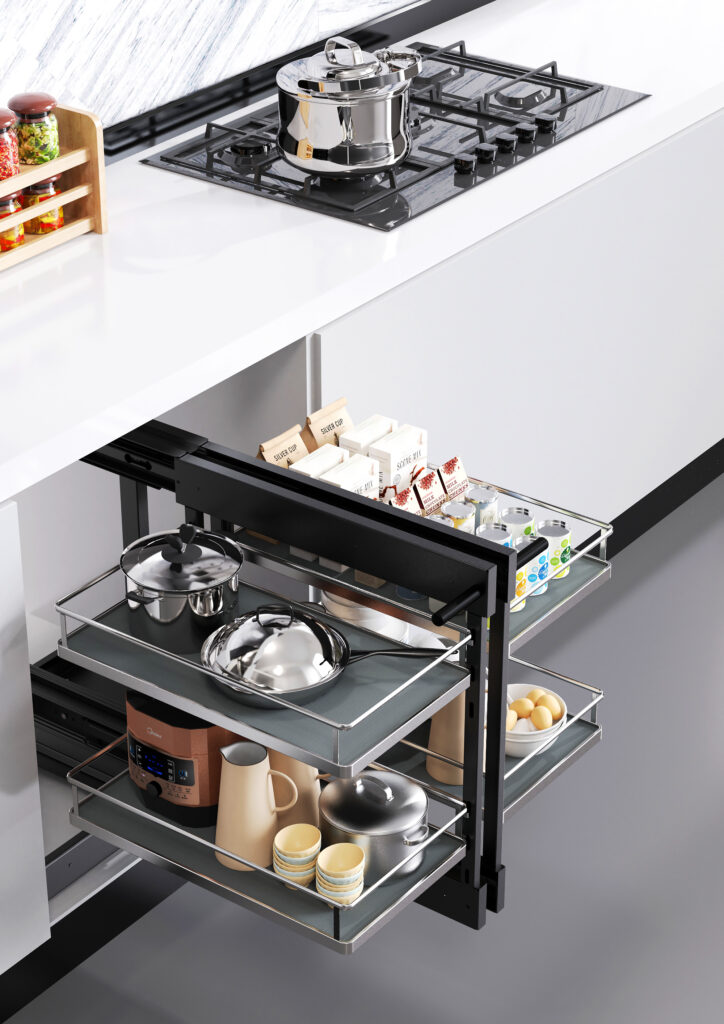
In short: An L-shaped kitchen has a corner cabinet, and the corner cabinet has a problem — much of its interior volume is unreachable from the door opening. “Magic corner” hardware solves this by bringing the dead space to the door, either by swinging shelves on a pivot or by pulling baskets out from the rear corner. The architecture you choose depends on the cabinet size, the door configuration, and the budget. For most residential L-shape kitchens, a swing-out shelf system or a turntable solution covers the case at a reasonable cost.
The corner-cabinet problem
A standard L-shaped corner cabinet has roughly half a cubic meter of internal volume, but if only one face is a door, an adult arm can reach maybe a third of it. The rest is dead space. Over the years, three families of hardware have emerged to address this.
Three solutions, ranked by cost
1. Turntable shelves (lazy susan)
Two circular or kidney-shaped shelves on a center post. Rotate them to bring contents to the door opening. The simplest and most affordable option; the trade-off is that the center post occupies some volume.
- Cabinet requirement: minimum 800 × 800 mm for 180° / 270°, 900 × 900 mm for 360°.
- Load per shelf: 8–15 kg depending on size and shelf material.
- Suited to: budget and mid-tier programs.
2. Swing-out kidney shelves
Two kidney-shaped shelves that swing through the door opening on a side-mounted pivot. Each shelf presents its full surface when swung out. More efficient volume recovery than a turntable; more moving parts.
- Cabinet requirement: minimum 900 × 900 mm with a door opening of at least 450 mm.
- Load per shelf: 10–15 kg.
- Suited to: mid-tier programs.
3. Pivot-and-pull-out systems
A door-attached basket pair plus a second basket pair that pivots out from the rear corner as the front pair clears the opening. Best volume recovery; highest cost.
- Cabinet requirement: minimum 900 × 1000 mm.
- Load per shelf or basket: 12–20 kg.
- Suited to: upper-tier programs.
Architecture comparison
| System | Min cabinet | Volume recovery | Load per shelf | Cost |
|---|---|---|---|---|
| Turntable 180°/270° | 800 × 800 | ~50% | 8–12 kg | Low |
| Turntable 360° | 900 × 900 | ~55% | 10–15 kg | Low |
| Swing-out kidney | 900 × 900 | ~60% | 10–15 kg | Mid |
| Pivot-and-pull-out | 900 × 1000 | ~65% | 12–20 kg | High |
How to specify a corner-cabinet program
- Confirm the cabinet face configuration — one door, one door with a blind face, or two doors.
- Measure cabinet inner width × inner depth at the floor.
- Decide the budget tier — that decides the architecture.
- Specify shelf material — chrome-plated wire for entry, 304 stainless for mid and upper tiers.
- Specify whether soft-close on the swing or pull-out motion is required.
For most residential L-shape programs we work on, a turntable or a swing-out shelf system covers the case at a price point that aligns with the rest of the cabinet build. Pivot-and-pull-out systems are worth the cost for upper-tier programs where the cabinet itself is positioned at a higher price.
FAQ
Q: Can I retrofit a corner system to an existing cabinet?
A: Most systems mount with screws to the cabinet floor and back wall, so retrofit is usually possible. The constraint is door opening width and cabinet inner dimensions.
Q: What is the difference between a “magic corner” and a “blind corner” pull-out?
A: Magic corner cabinets have doors on both adjacent faces. Blind corner cabinets have one door and one fixed panel against a wall — the hardware pulls baskets out from behind the fixed panel.
Q: How loud are turntable shelves in use?
A: A sealed-bearing turntable operates quietly. Bushing-bearing versions can get louder over time as the bushings wear.
Q: What material do you recommend for the shelves?
A: For mid-tier programs, 304 stainless or a stainless rim with a melamine deck. For entry programs, chrome-plated wire with proper plating thickness.
Q: Can the shelves be height-adjustable?
A: Yes — most systems allow vertical adjustment in 25 mm steps on the carrier post.