
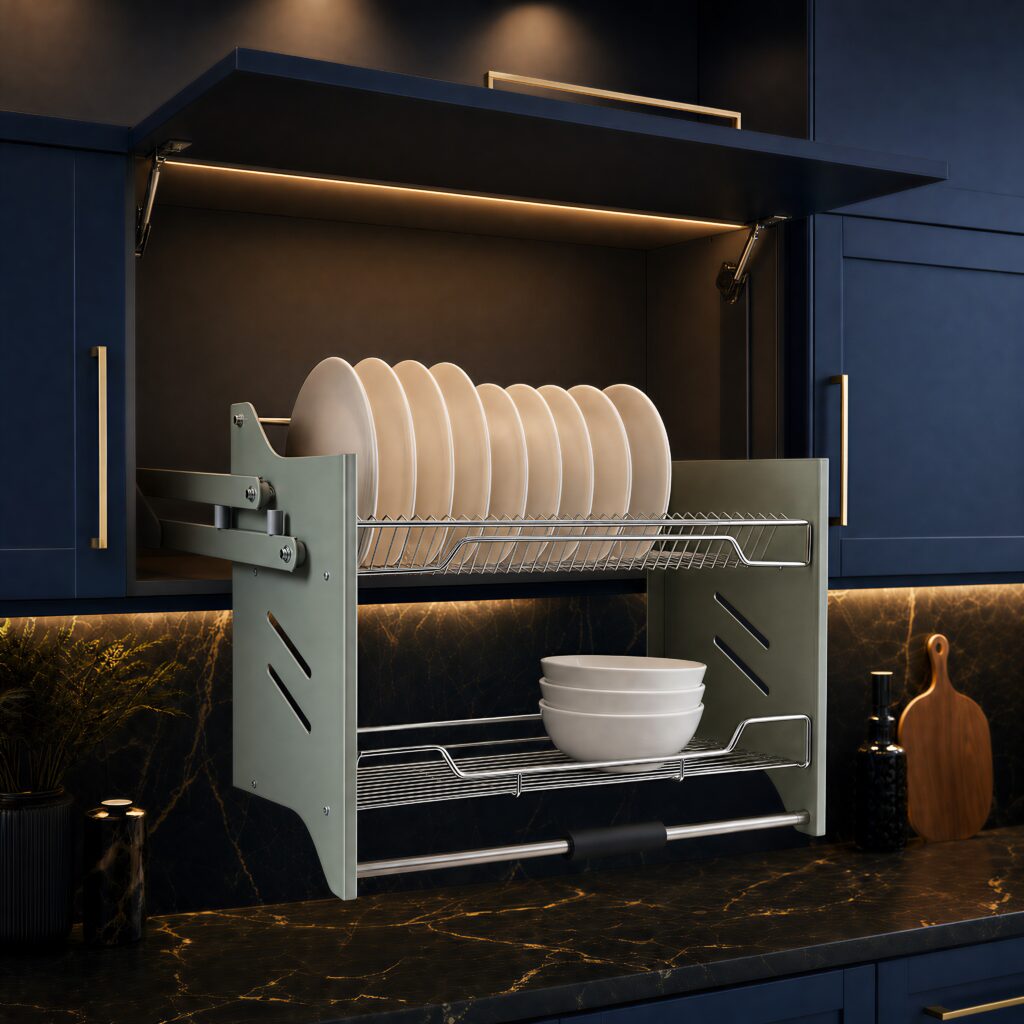
In short: A wall-cabinet pull-down lift basket sits inside the upper wall cabinet. A handle is pulled forward and the basket swings out and down on a counter-balanced arm, bringing the dishes, glassware, or dry goods to a working height that does not require a step stool. This is a category our factory makes — under the LIFT_BASKET series — and what this article covers. We make these in 304 stainless and chrome-plated steel, sized to the common wall-cabinet widths from 600 mm to 900 mm. Below: how the mechanism works, what to specify, and the load and sizing ranges that fit residential and small-commercial use.
What a pull-down lift basket actually does
Standard upper wall cabinets put their contents at a height of around 1,500 to 2,000 mm from the floor. The top shelf of a tall wall cabinet is often above a normal user’s reach without a stool. A pull-down lift basket attaches to the cabinet sides and carries the basket on a counter-balanced arm. Pulling the front handle moves the basket forward and downward in one motion; the basket settles at a working height in front of the cabinet face. Releasing the handle lets the counter-balance return it to the stored position inside the cabinet.
This makes the upper portion of a tall wall cabinet genuinely useful, not just storage that the household forgets about.
Our product range — what we make
| Model | Cabinet width fit | Configuration | Material options |
|---|---|---|---|
| LIFT_BASKET_A | 600–800 mm | Two-tier wire basket | Chrome-plated, 304 stainless |
| LIFT_BASKET_B | 600–900 mm | Two-tier with side rail | Chrome-plated, 304 stainless |
| LIFT_BASKET_C | 700–900 mm | Two-tier with dish-rack insert | Chrome-plated, 304 stainless |
Typical load and sizing
- Loaded weight — around 8–15 kg distributed across both tiers. This is the working load; the mechanism is rated above this so it returns reliably.
- Wall cabinet inner depth — typically 300–330 mm, which is the standard residential wall cabinet.
- Cabinet inner height — at least 600 mm for two-tier models so the basket has room to slide vertically inside the cabinet.
- Counter-balance — sized at the factory to the basket weight and rated load. The user feels a constant low pull-force across the travel arc, not a heavy resist-then-release.
What to specify in the RFQ
- Wall cabinet outer and inner width in mm.
- Wall cabinet inner depth and inner height.
- Basket configuration — wire only, dish rack, or with side rail.
- Material — chrome-plated steel for entry tier, 304 stainless for mid and upper tier.
- Expected loaded weight in kg.
- Whether the cabinet is over a worktop (working height matters more) or against an open wall.
Where pull-down lift baskets fit, and where they don’t
They fit residential kitchens with tall upper cabinets, small-commercial kitchens that need step-free access to upper storage, and accessibility-friendly designs for users who cannot use a stool safely. They do not fit cabinets shallower than 280 mm of inner depth (the mechanism needs clearance), and they are not the right answer when the cabinet is very low — a simple shelf at hand height works better and costs less.
FAQ
Q: Does the pull-down need any electrical assist?
A: No — the systems are mechanical, with a counter-balance spring sized to the basket and rated load. No power, no wiring.
Q: Can the user adjust the counter-balance?
A: The factory sets it to the basket and rated load. Field adjustment is typically not necessary; if loaded weight changes substantially after install (e.g., a dish-rack insert was added later), the system can be tuned.
Q: How loud is the pull-down motion?
A: Quiet through the motion arc. Sealed-pivot mechanisms operate quietly for years; lower-cost bushing pivots get louder over time.
Q: Can it be retrofitted to existing cabinets?
A: Yes — the carrier rails screw to the cabinet side walls. The constraint is cabinet inner dimensions matching the system requirements.
Q: What’s the most common installation mistake?
A: Cabinet sides that are not parallel. A wall cabinet built out of square will bind the lift mechanism, which is a square-load device. Always check parallel before mounting.