
In short: The difference between a pull-out basket that lasts five years and one that lasts fifteen is not in the product photograph. It is in the steps between raw coil and packed carton — raw material grading, wire straightening, bending, welding, plating or passivation, loaded cycle test, and salt-spray sampling. We do all of these in-house, and we are willing to walk any serious buyer through every step. This article is what that walk-through covers.
Step 1 — Raw material in
Coils of steel wire arrive marked with mill certificates. For chrome-plated lines we use low-carbon steel wire; for stainless lines we use 304 stainless wire. The mill certificate must show the alloy chemistry — for 304 that means roughly 18% chromium and 8% nickel. Coils that do not match the certificate are returned to the supplier. This is not exciting work but it is the foundation; a substrate that is wrong on day one cannot be fixed at the welding station.
Step 2 — Straightening and cutting
Coiled wire goes through a CNC straightening and cutting machine. The output is straight wire of consistent length, ready for bending. The tolerance we hold here decides whether the welded assembly comes out square; a 2 mm drift on cut length compounds into a visibly skewed basket after twelve weld points.
Step 3 — Bending
Bent shapes are formed on CNC benders set up to the part program. Spring-back is compensated per material — stainless springs back more than mild steel, so the over-bend angle is set differently for each line. Bent sub-assemblies are checked against a fixture before they move to welding.
Step 4 — Welding
Two welding methods cover most of what we make:
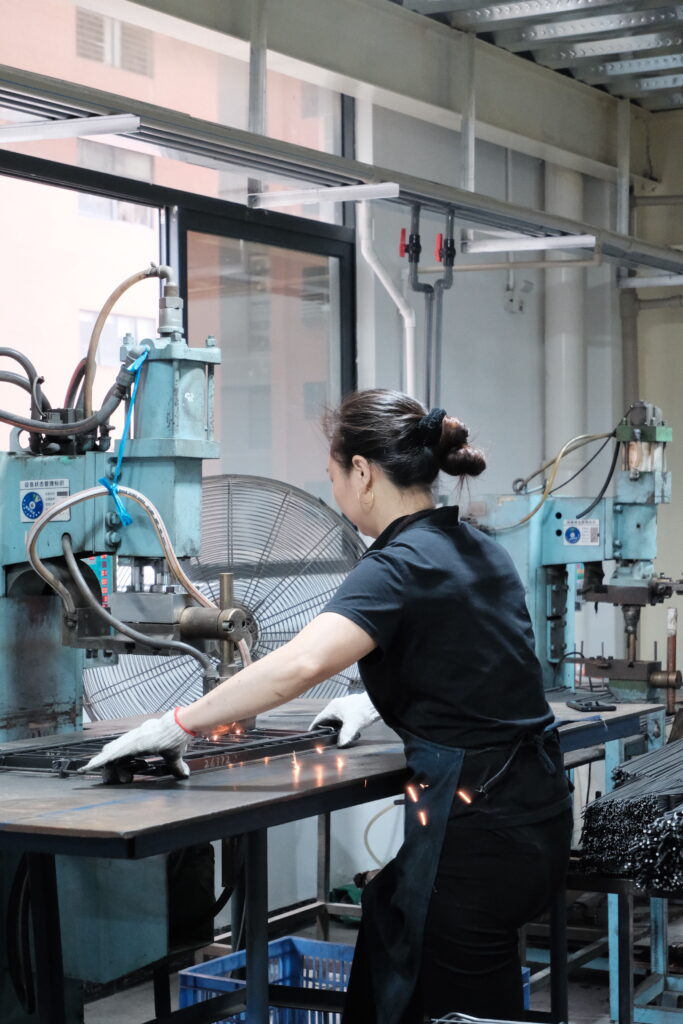
- Resistance spot welding for chrome-plated low-carbon steel — fast, clean, and well-matched to the substrate.
- TIG welding for 304 stainless — slower per joint, but a clean TIG weld on stainless passivates back to the parent material’s corrosion resistance.
The welder is the highest-skill role on the line, and our welders have years of tenure. The welding station is where most field failures actually originate; we treat it that way.
Step 5 — Finishing
Welded baskets are hand-checked, ground at weld points to remove flash, and prepared for surface finishing:
- Chrome-plated line — degrease, acid pickle, nickel underlayer, chrome top coat, rinse, dry.
- Stainless line — pickling and passivation in a controlled bath to restore the chromium-oxide layer that welding heat disturbs.
Step 6 — Testing
What we test:
- Loaded cycle test — every runner assembly cycles through a loaded test before packing. Failures here are caught before they ship.
- Salt-spray sampling — chrome-plated batches sampled per production run at 48–96 hours per ASTM B117 method. Failures trigger a batch hold and a plating-line review.
- Dimensional check — on-line operator inspection plus periodic gauge check by the line supervisor.
Step 7 — Packing and shipping
Final packaging includes a batch code stamped on the frame. The code resolves back to the production date, line, operator, raw-material lot, and test results. If something does fail in the field, we can trace it.
FAQ
Q: How can a buyer verify these tests are real?
A: We share dated, signed test records on request, including the raw instrument readings. You are also welcome to visit and watch a run.
Q: How long does the full cycle take for a new OEM program?
A: Around 14 to 22 weeks from PO to FOB, with tooling taking the largest share. Re-orders on existing SKUs are much faster — typically 30 to 45 days.
Q: What happens if a batch fails salt-spray?
A: The batch is held. We review the plating-line variables — bath chemistry, current density, dwell time, substrate cleanliness — and only release the batch after a corrected run passes the same test.
Q: Can buyers attend a production run?
A: Yes, by appointment. First-article inspection by the buyer is common on new programs.
Q: Is the process the same for stainless and chrome-plated lines?
A: The first half (raw material, straightening, bending, welding) is similar. The finishing and testing differ — stainless does not need plating; chrome-plated does not need passivation. Same factory, different specialized lines.