
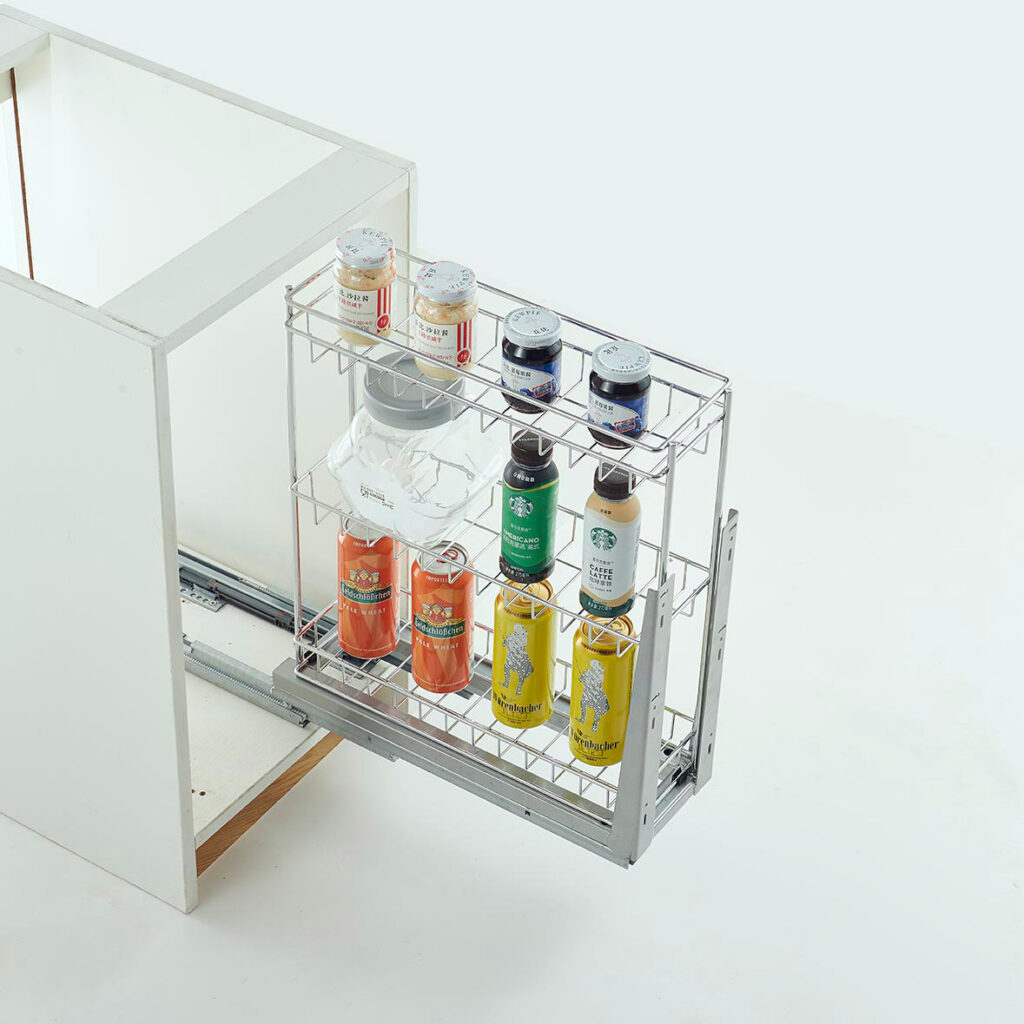
In short: Aluminum-alloy kitchen hardware has a genuine niche — it is lighter, corrosion-resistant without plating, and accepts anodized colorways directly. It also has trade-offs: lower tensile strength than steel, higher raw-material cost than chrome-plated wire, and it is best made by factories that specialize in extrusion-frame work. We do not specialize in aluminum. Our focus is 304 stainless and chrome-plated steel-wire baskets, which is what our lines are tooled for and what our process control is built around. This article is a fair explanation of what aluminum is and is not — and an honest note about why we point aluminum-focused buyers to factories that do it well.
Where aluminum fits in kitchen hardware
Aluminum-alloy hardware shows up most often as:
- Frame profiles for design-led drawer organizers, especially in visible glass-fronted cabinets.
- Lift-system components where lower moving mass helps spring or damper life.
- Anodized colorway products (anthracite, matte black, champagne) where the finish is achieved during the anodizing process rather than as a secondary plating step.
None of these is wrong. For programs where these specific features matter, aluminum is the right answer.
What aluminum is honestly good at
- Weight — aluminum is roughly a third the density of steel. For lift systems where mass affects spring life, this matters.
- Corrosion behavior without plating — aluminum forms a self-passivating oxide that resists most kitchen-environment exposure.
- Finish flexibility — anodizing accepts color injection in one process, which simplifies the production sequence for matte and dark colorways.
What aluminum is honestly not as good at
- Absolute load strength — steel handles point and impact loads better at the same cross-section.
- Welding-friendly fabrication — aluminum can be welded, but the heat-affected zone loses temper strength and requires more care than steel.
- Raw material cost vs chrome-plated steel — aluminum is several times the cost per kilogram of low-carbon steel wire. For entry-tier programs, it does not compete.
Why we do not specialize in aluminum
Our lines are set up for wire bending, resistance and TIG welding, electroplating, and passivation — the process chain for steel-substrate baskets. Aluminum extrusion frames are a different production sequence with different machines and different operator skills. We could quote on aluminum products, but the honest answer is that factories specializing in aluminum extrusion will do it better than we would.
This is a deliberate choice. We would rather make a tighter product range well than a wider range we cannot stand behind. If your program is primarily aluminum, we will tell you to look elsewhere. If your program is steel-substrate baskets — chrome-plated or 304 stainless — we are confident we can serve it.
FAQ
Q: Will you quote on a mixed program that includes some aluminum SKUs?
A: We will quote on the steel-substrate SKUs honestly. For the aluminum SKUs, we will tell you what we can and cannot do, and where appropriate we will recommend you split that portion of the program to a specialist factory.
Q: Is aluminum suitable for coastal kitchens?
A: Yes — anodized aluminum resists chloride exposure well. 304 stainless is also a strong fit for coastal kitchens, and is where our specialty lies.
Q: How does anodized aluminum compare to powder-coated steel on appearance?
A: Anodized aluminum integrates the color into the oxide layer, so it does not chip the way a coating can. Powder-coated steel has a wider color palette and a thicker finish that hides minor surface variation.
Q: Why does aluminum cost more than chrome-plated steel wire?
A: The raw material is several times more expensive per kilogram, and extrusion tooling adds capital cost. The finished product reflects both.
Q: Are aluminum and stainless similar in price at the finished product level?
A: Roughly comparable at the ex-works level for similar product complexity. The decision is not usually about cost — it is about which fits the design and end-use environment.