
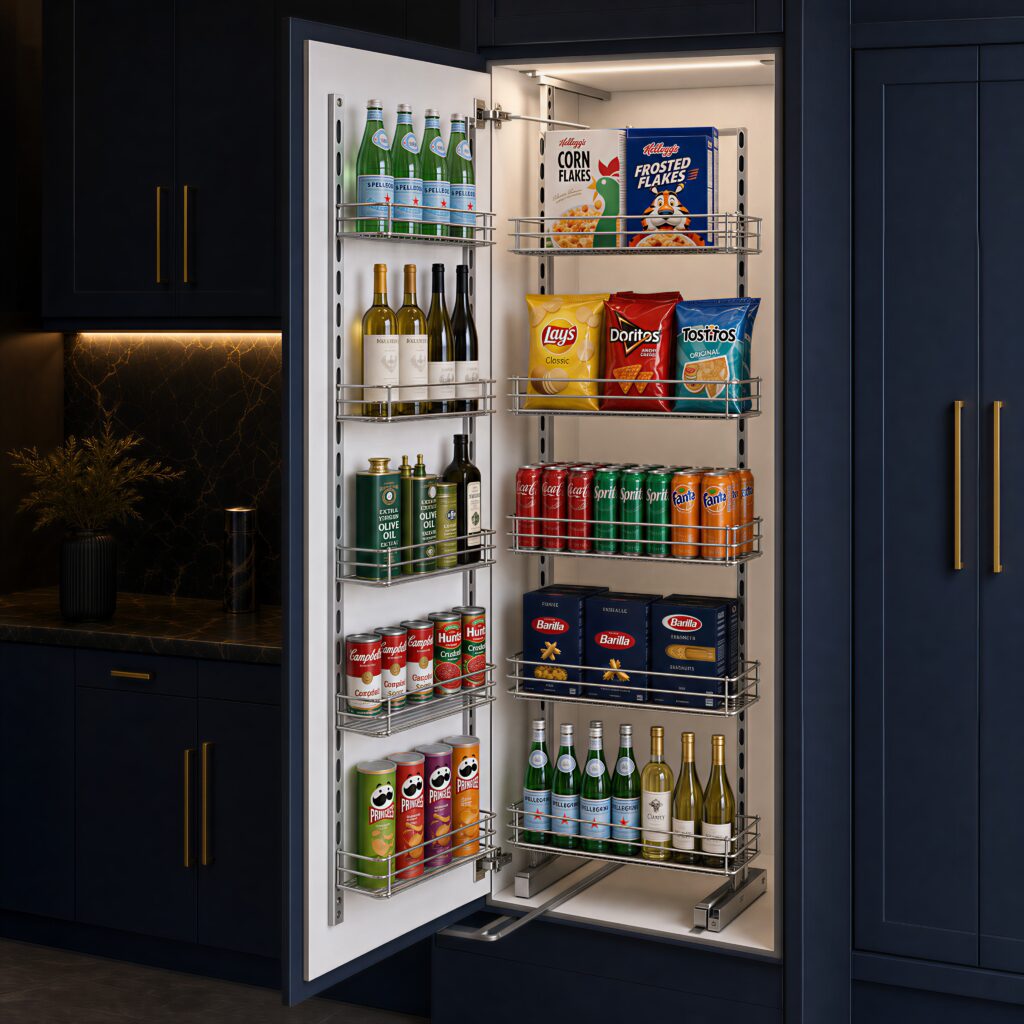
In short: tall unit pull-outs are specified by cabinet height, cabinet width and total loaded weight — in that order. Common heights cluster around 1800, 1950 and 2150 mm; widths run 300–600 mm. The number buyers most often underestimate is total load: a full larder can carry 60–80 kg, and the runner system, not the basket, is what determines whether it survives.
These are the highest-value items in a storage catalogue and the ones with the least tolerance for a sloppy specification.
The three numbers that define a tall unit
Height. The market has settled around three bands: roughly 1800 mm, 1950 mm, and 2150 mm, with the taller options common in European kitchens with adjustable plinths. Systems are usually supplied with adjustable shelf positions so one frame covers a height band rather than a single dimension.
Width. 300 and 400 mm are the volume sizes; 500 and 600 mm appear in project work and larger kitchens. Narrow tall units (300 mm) are the classic filler solution beside a fridge housing.
Load. This is where specifications go wrong. A 400 mm larder filled with bottles, tins and packets is heavy. Ask for the rated load of the complete system, not of the basket, and confirm whether that figure is static or tested through cycles.
Frame types and what they cost you
| Type | How it works | Best for |
|---|---|---|
| Single-frame pull-out | One frame with fixed or adjustable shelves, runners on both sides | Straightforward larders, best value per litre of storage |
| Linkage / synchronised | Inner and outer baskets move together as the door opens | Deep units where reaching the back matters |
| Door-mounted tall unit | Frame travels with the door | Seamless look; requires tighter cabinet tolerances |
Where tall units fail in the field
Runner undersizing. The single most common failure. A runner rated for a base drawer will sag under a full larder within months.
Frame rigidity. Tall frames flex. Welded joints and adequate wire gauge matter more here than anywhere else in the catalogue — see our guide on reading a wire basket spec sheet.
Cabinet squareness. A tall unit amplifies any out-of-square in the carcass. On site, this shows up as a unit that binds near the top of its travel.
What to confirm before ordering
Cabinet height band and internal clear width; whether the plinth is included in the height you quoted; rated system load; runner type and whether soft-close is required; framed or frameless construction. Send those and a quotation is a same-day exercise.
FAQ
What height tall unit should I order?
Match the cabinet height band rather than a single figure — most systems have adjustable shelves covering a range. Confirm whether your stated height includes the plinth, which is where the majority of ordering errors come from.
How much weight can a tall pull-out carry?
It depends on the runner system rather than the basket. Ask for the rated load of the complete assembly and whether the figure is static or cycle-tested. A fully loaded larder can reach 60–80 kg in normal use.
What is a linkage or synchronised system?
Inner and outer baskets are coupled so both move as the door opens, bringing rear contents forward. It costs more but solves the reach problem in deep units.
Can tall units be made to non-standard heights?
Yes, under an OEM programme against your cabinet drawings. Standard height bands cover most projects at a much lower cost, so we usually recommend confirming that a standard band genuinely does not work first.
Working on a specification or a quotation? Talk to our team — we reply within 24 hours, or request the full catalog.