In short: Selecting a kitchen hardware manufacturer is a multi-year decision, not a single PO. The eight questions below are the ones we wish more buyers asked us before sending the first order. They are not designed to make a factory look impressive — they are designed to surface whether the factory and the buyer fit. A factory that answers six of eight clearly, in writing, is being honest about what it is and is not. That is more useful than a factory that claims it can do everything.
Why these questions matter
Switching factories halfway through a program is expensive — re-tooling, re-certification, re-approvals with end buyers. The questions below are designed to surface a structural fit before you commit. None of them are difficult to answer for a real factory; if the answers are evasive or generic, that itself is the signal.
1. Are you a factory, a trading company, or somewhere in between?
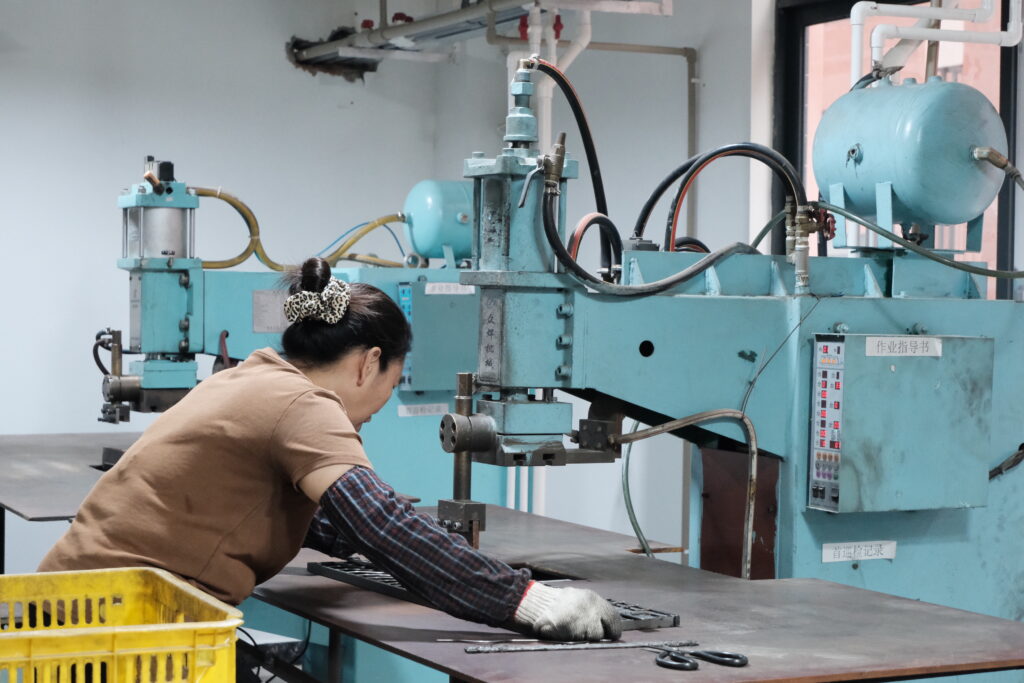
Real factories own their welding lines and plating tanks. Trading companies aggregate small workshops behind one sales front. There is a middle category — workshops that own some processes and outsource others. None of these is automatically wrong; what matters is that you know what you are buying. Ask for a business license that lists production scope, the workshop address, and a video of the line.
2. How long have you been making this category?
Tenure in a category matters more than year-of-establishment. A factory that has made the same kind of product for ten-plus years has stable batches. A factory that pivots from lighting to hardware to whatever is selling will have a learning curve on your program. We have been making kitchen pull-out hardware specifically for over two decades.
3. Can you walk me through your typical production sequence?
A factory that knows its process can walk you through it without rehearsal: raw material in, straightening and cutting, bending, welding, finishing, testing, packaging. If the answer is a marketing pitch instead of a process description, the operations team and the sales team are not connected.
4. What in-house testing do you run, and on what cadence?
Honest answers we like to hear:
- Salt-spray testing on chrome-plated batches — sampled per production run.
- Loaded cycle testing on runner assemblies — every unit, not just samples.
- Visual and dimensional inspection on the line.
What we do not claim: laboratory-grade equipment we do not own. Buyers asking the same question of three suppliers can spot inflated claims fast.
5. Which certifications do you actually hold, and which are current?
Minimum baseline for export programs: ISO 9001. We have held ISO 9001 for multiple consecutive years. Other certifications (social compliance audits, environmental management) depend on your destination market — ask for the current PDFs with valid expiry dates rather than a list on a website.
6. Can you give me three references — buyer name, SKU, destination country?
A factory that has been exporting for years can name reference customers, even if specific volumes are under NDA. A factory that cannot name a single buyer is either new to export or in a category where references are not standard.
7. What is your realistic lead time at busy and quiet periods?
Stated lead times without context are not useful. A factory at 50% capacity utilization might quote 25 days; the same factory at 90% utilization in Q3 might need 55. Ask for both. The willingness to give you the realistic number is itself the signal.
8. What does your typical return rate look like?
A factory tracking quality at the SKU level can answer in numbers. We track ours; the figure we are willing to share with buyers under NDA is well under 1% on functional hardware. A factory that answers “almost zero” without specifics either does not measure or does not want to.
FAQ
Q: Should I visit the factory before placing a first order?
A: For a program above USD 80,000 first-order value, we recommend it. We host buyer visits and credit reasonable travel costs against the first order. It saves both sides time later.
Q: Can I commission a third-party audit if I cannot visit?
A: Yes. Audit firms run one-day factory audits at modest cost. We welcome them — a clean audit report is easier to share than a marketing brochure.
Q: How long should evaluation take before placing a first order?
A: Six to ten weeks for a mid-tier program: RFQ, samples from a few finalists, lab or in-cabinet testing, then contract. Faster evaluations sometimes work; rushed evaluations usually don’t.
Q: What’s the single biggest red flag?
A: Inability to produce a recent electricity bill, a production schedule, or three named reference customers. Each individually is a yellow flag; all three together usually means the supplier is not what it claims.
Q: Do you accept on-site inspection during production?
A: Yes — buyer-attended runs are normal for first-article inspection on new programs. We schedule a line slot and set up a buyer-side inspection desk.