
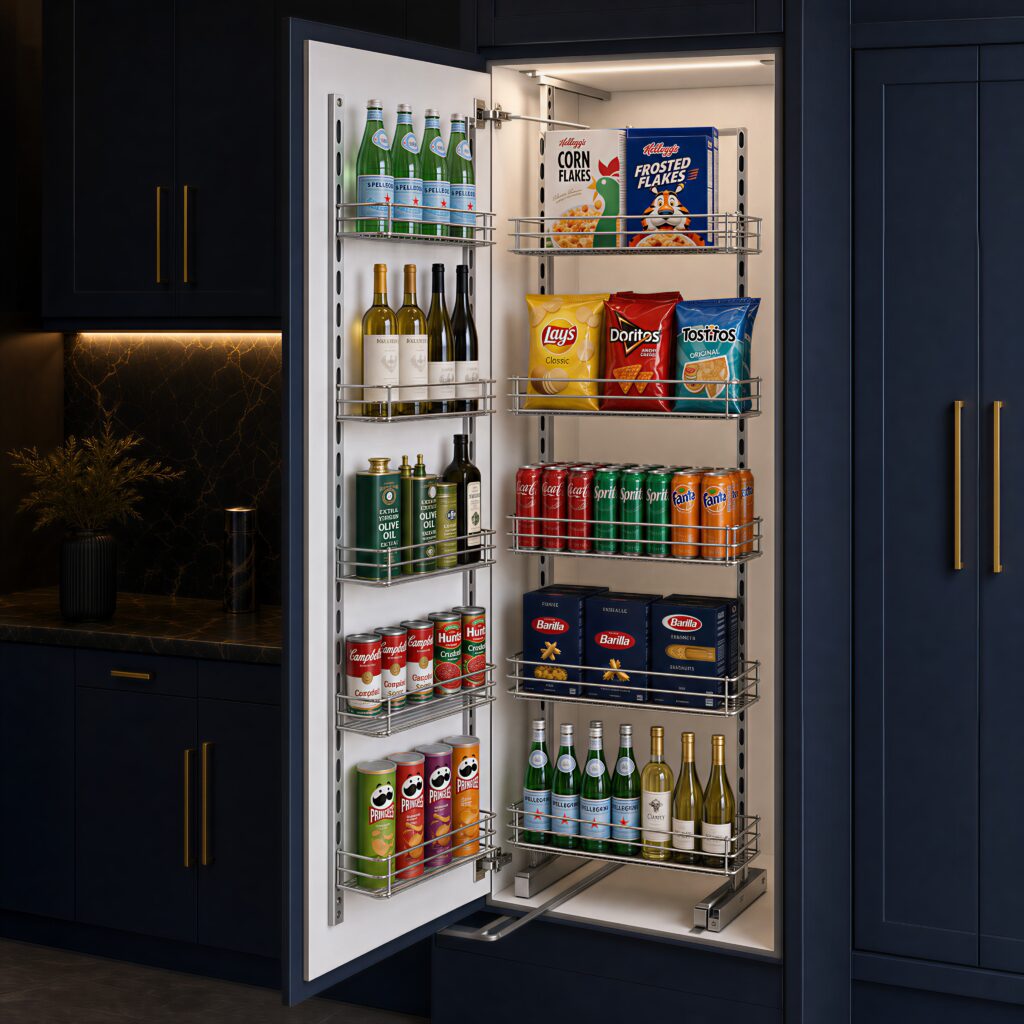
In short: Three changes are reshaping kitchen storage hardware sourcing in 2026 — cabinet makers are asking for more SKUs per cabinet width range, 304 stainless steel as the default basket material in mid-tier programs, and integrated soft-close as a baseline expectation, not an upsell. None of these is new technology. What changed is that buyers stopped accepting the same product in different packaging and started asking for consistent batches, predictable lead times, and a factory that has been making the same thing for years rather than chasing whatever sold last quarter.
What we are seeing from buyers in 2026
We have been making kitchen pull-out baskets and cabinet hardware in Zhongshan for over two decades. The conversations with overseas cabinet buyers in 2026 are different from three years ago in a few specific ways.
First, the SKU range expectation is wider. Where a buyer used to standardize on three cabinet widths, the same buyer in 2026 typically asks for six to eight — 200, 300, 400, 450, 500, 600, 800, and 900 mm. The expectation is that the factory carries the molds for all of them, not that the buyer has to choose between a tooled width and a workaround.
Second, material defaults shifted. 304 stainless steel is now the default material in the mid-tier basket range, where it used to be chrome-plated steel wire. Chrome-plated wire still sells in volume at the entry tier — it is reliable when properly plated, and there is no reason to oversell stainless where a plated product fits the budget — but the mid-tier RFQ now starts with 304 unless the buyer specifies otherwise.
Third, soft-close is no longer an upsell line item. It is built into the runner expectation. Buyers do not want to see an RFQ where soft-close is a column on the price comparison; they want it included and tested.
Cabinet width modules we ship most
| Cabinet width | Typical basket nominal | Common use |
|---|---|---|
| 300 mm | 250 mm | Spice / utility column |
| 400 mm | 350 mm | Under-sink, narrow base |
| 450–500 mm | 400–450 mm | Mid-base storage |
| 600 mm | 550 mm | Standard base, most common |
| 800 mm | 750 mm | Wide base, cookware |
| 900 mm | 850 mm | Pantry / tall-cabinet base |
Where we focus, and where we don’t
We specialize in chrome-plated steel wire baskets and 304 stainless steel pull-out systems. That is what our lines are tooled for, what our welders are trained on, and what our process control is built around. We do not chase aluminum-frame products — those exist and have their place, but they are not our strength, and we would rather make a smaller range well than a wider range we cannot stand behind.
The same logic applies to the rest of the hardware ecosystem. We make baskets, drawer organizers, and corner systems. We do not make hinges and we do not make runners — we source those from partners we have worked with for years and assemble the complete system. That keeps our quality control focused on the parts we actually manufacture.
What we test on every production run
- Salt-spray test — 48–96 hours on chrome-plated batches, sampled per production run. Stainless batches do not need this test because the substrate is the corrosion barrier.
- Loaded cycle test — every runner assembly cycles through a loaded test before packaging, not just sampled units.
- Visual and dimensional check — every basket on the welding line is inspected by the operator before it leaves the station.
We have held ISO 9001 certification for multiple consecutive years. The certification is a baseline, not a marketing claim — what matters is whether the process control behind it is honest about what changed between Batch 1 and Batch 200.
What this means for sourcing decisions in 2026
If you are sourcing for a 2026 program: expect the wider SKU range to be the new normal, expect 304 stainless to be the mid-tier default, and price soft-close into the line item rather than treating it as an upsell. Factories that already work this way will quote consistently; factories that don’t will quote low and add cost during the program.
FAQ
Q: Why 304 stainless and not 316L?
A: 304 covers nearly every residential kitchen application. 316L is genuinely better in direct seawater exposure or specific industrial environments — but those are rare in residential cabinet hardware, and specifying 316L where 304 works is paying for a margin you will not use.
Q: What cabinet widths can you produce baskets for?
A: 200 to 900 mm in our standard tooling, with 600 mm being our highest-volume size. We carry molds across the range; you do not have to standardize on one width to get a stable batch.
Q: How long is a typical re-order lead time?
A: For SKUs we already tool, around 30–45 days from PO to FOB Yantian or Mawan, depending on factory load. Re-orders during peak season (Q3 in our case) can run longer; we tell buyers the realistic lead time, not the marketing one.
Q: Do you offer customization?
A: Yes — colorway, logo, packaging, and minor dimensional variants on existing platforms. Full tooled-from-scratch programs require an MOQ discussion and a longer NPD timeline.
Q: What’s the most common sourcing mistake you see?
A: Buyers choosing the lowest quote without checking whether the factory actually controls plating thickness and weld consistency batch-to-batch. The unit cost difference disappears within the first season of returns.