
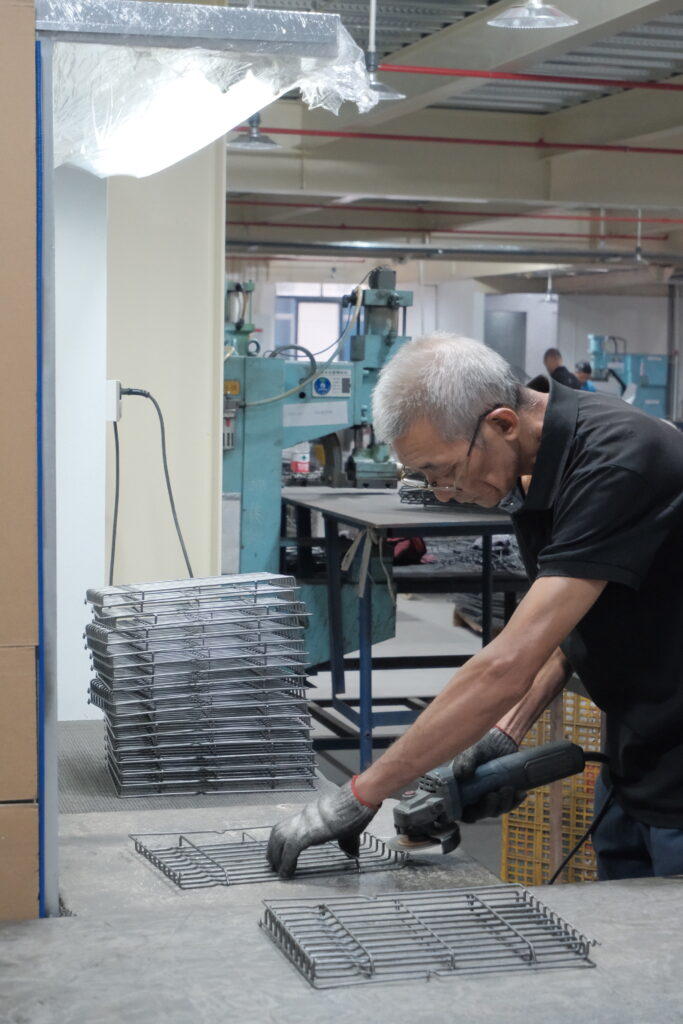
In short: the defects that reach end customers in this category are rarely dramatic. They are missed welds, thin plating at weld points, burrs on cut ends, out-of-square frames and runners that bind under load. Every one of them is catchable in a five-minute check on the factory floor, and every one of them is expensive once it has crossed an ocean.
This is our own defect list — the things we look for because they are the things that go wrong.
Five defects, and what causes each
1. Missed or cold welds. Cause: welding parameters drifting during a long run, or an operator working faster than the fixture allows. Symptom: an intersection that separates under load, usually where the infill meets the frame. Check: flex the base by hand and listen; run a finger along every crossing on a sample.
2. Thin plating at weld points. Cause: inadequate cleaning of the heat-affected zone before plating. Symptom: rust appearing at weld joints months before the rest of the basket shows anything. Check: look directly at weld points under strong light — the finish should be continuous, not dulled or greyish there.
3. Burrs and sharp cut ends. Cause: skipped deburring, or blades run past their service life. Symptom: snagged contents, complaints from end users, and in retail programmes, returns. Check: run a cloth along cut ends; it should not catch.
4. Out-of-square frames. Cause: fixture wear or a rushed setup after a size changeover. Symptom: a basket that binds in the cabinet or sits visibly crooked. Check: measure both diagonals on a sample — they should match within a couple of millimetres.
5. Runners that bind under load. Cause: mounting brackets welded slightly out of alignment, or a runner undersized for the application. Symptom: smooth operation when empty, stiff or noisy when loaded. Check: cycle a sample loaded to the rated weight, not empty.
Why these appear late in a production run
Almost all of them are drift problems rather than design problems. The first hundred pieces off a fixture are usually fine; the last thousand are where wear, fatigue and schedule pressure show up. That is precisely why a pre-shipment inspection at 80–100% completion catches more than an early-production check — the reasoning behind pre-shipment inspection.
What a factory should be doing about it
| Control point | What it prevents |
|---|---|
| Incoming wire inspection | Wrong gauge or grade entering production |
| First-article approval after each setup | Out-of-square frames from fixture changes |
| In-process weld sampling | Parameter drift mid-run |
| Pre-treatment cleaning check | Thin plating at weld zones |
| Loaded-cycle test on samples | Runner binding that empty testing misses |
| Final visual and dimensional check | Burrs, finish blemishes, packing errors |
Ask any supplier which of these they actually run, and ask to see the records rather than the poster on the wall. A quality system that exists produces paperwork; one that does not, produces reassurance.
FAQ
What is the most common defect in wire kitchen baskets?
Missed or cold welds, followed closely by thin plating at weld points. Both come from drift during long production runs rather than from design, which is why late-stage inspection catches more than early checks.
How do I check for weld quality without equipment?
Flex the base of a sample by hand and listen for movement at intersections, then inspect weld points under strong light for finish continuity. Neither test is laboratory-grade, but both catch the failures that actually reach customers.
Can defective goods be reworked in China?
Often yes, and it is far cheaper than dealing with them after arrival. This is the practical argument for inspecting before shipment: rework at the factory costs a delay, rework after landing costs the margin on the order.
What does SOWELLE check on every production run?
Incoming material, first-article approval after each setup, in-process weld sampling, pre-treatment cleaning, loaded-cycle testing on samples, and a final visual and dimensional check. Records are available to buyers on request.
Working on a specification or a quotation? Talk to our team — we reply within 24 hours, or request the full catalog.